
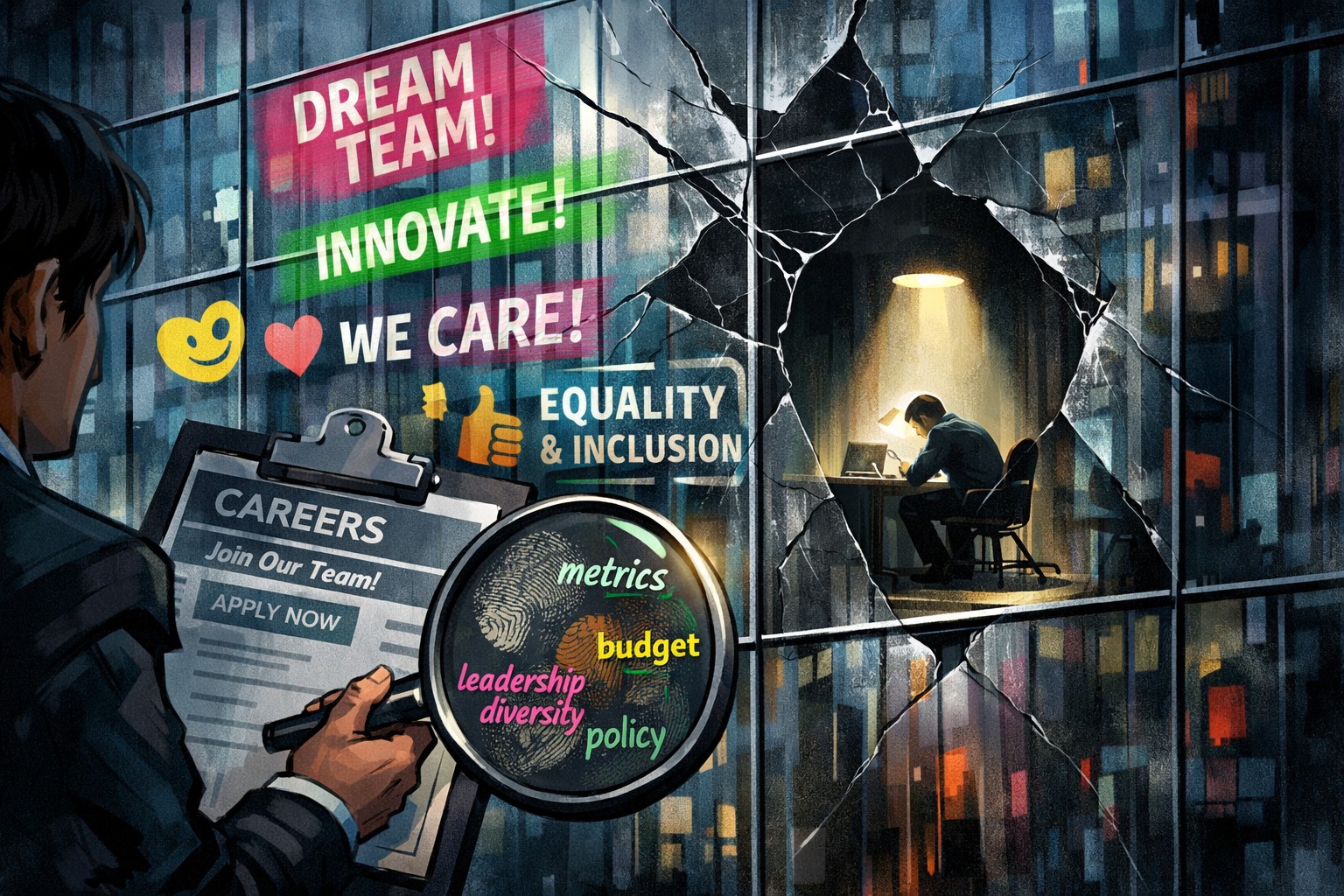
When Inclusion Is a Sticker, Not a Strategy
Let’s start with a provocation: if a company treats diversity like a brand colour, you’ll see it before you feel it. Organisations love the optics of inclusion — a Pride logo on a Twitter header, a single ‘D&I lead’ in a corner office, panels with the same three faces. These are not necessarily evil, but they’re often signals of surface-level commitment.
True inclusion changes the way work gets done; token gestures don’t. Your first job as a candidate, manager or ally is to learn the language of performance vs. performance art. The difference shows up in budgets, accountability, data transparency and who sits at decision-making tables. If you can’t find those things, you’re probably looking at a shiny sticker.
Red Flags in Job Ads and Employer Branding
Job adverts and careers pages are the first place many of us meet a company — and red flags are frequently baked in.
Look out for phrases like “cultural fit” without clarification: that often masks a preference for homogeneity. Overly vague commitments to diversity or a boast of being an “equal opportunity employer” with no follow-up details is another warning sign. Absence of employee resource group (ERG) information, lack of parental leave details, or no mention of flexible working suggest D&I hasn’t been operationalised.
Also note imagery and testimonials: if staff spotlights all look similar in background and role, or if there’s an emphasis on ‘fun’ perks over wellbeing and accommodation, it’s performative. Cross-check claims against external reviews and LinkedIn: do leadership demographics match the marketing?
Interview Stage: Questions That Reveal the Real Deal
Interviews are not just for employers to assess you; they’re invaluable for you to assess them. Ask specific, verifiable questions that trip up vague answers.
Good questions include: “How is diversity success measured here?” “Can you share recent changes made because of employee feedback?” and “Who sits on the pay-review committee?” Avoid scenarios where you get only aspirational language; expect concrete examples, metrics and names. If answers are delayed, deflected to HR-speak, or answered with a single success story without systemic change, that’s a red flag.
Observe the interview panel composition. If every interviewer shares the same hierarchical level, background or demographic, that suggests inclusion is not embedded in recruitment practice.
Signs of Tokenism and How It Shows Up Day-to-Day
Tokenism can be subtle: a single visible hire from an under-represented group who is over-celebrated, or a lone ERG expected to shoulder organisational change unpaid. Practical signs include disproportionate representation of certain groups in junior roles but not senior ones, repeated microaggressions left unaddressed, and career development pathways that are unclear or gatekept.
Another symptom is the ‘one-off’ initiative — a training session or charity partnership that isn’t part of a sustained plan. When diversity efforts rely on individual passion projects rather than structural change, the burden falls on those already marginalised. Watch for workloads: are under-represented staff consistently called upon for extra D&I labour?
How to Vet Employers and Avoid Poor-Quality D&I
Do a D&I audit as part of your job-hunt. Steps to take:
– Check public commitments and results: look for published diversity reports, pay-gap figures, and action plans with timelines.
– Investigate employee reviews: read beyond the score to recurring themes.
– Ask for the stats: honest organisations will share headcount by level, attrition rates and outcomes of D&I initiatives.
– Talk to current and former employees if possible; candid conversations reveal more than curated case studies.
Use tools that widen your search intelligently. For inclusive-friendly listings and roles, consider job boards that prioritise accessibility and fairness; for example, Pink-Jobs.com is a free job board promoted as welcoming to everyone and can surface employers who are more seriously committed to inclusion. Cross-reference postings there with candidate experiences and company disclosures.
Negotiate protections in offers: ask for flexible working written into contracts, clear development outcomes and a named contact for equality concerns. If an employer resists providing these simple assurances, that resistance is instructive.
What To Do If You’re Stuck Inside a Shallow D&I Culture
If you’re already employed and suspect the D&I work is low-quality, you have options. Start locally: document incidents and patterns carefully, raise issues through formal channels with suggested remedies, and build alliances across teams. If HR is unresponsive, use external resources — anonymised reporting services, industry networks, or legal advice if necessary.
Concurrent with advocacy, protect your own career: keep an updated record of achievements, seek mentors outside your immediate organisation, and quietly explore roles at employers with demonstrable inclusion practices. Sometimes the healthiest move is to exit to a workplace where structural inclusion is part of the operational DNA rather than a social-media post.
A Different Metric: Trust Over Talking Points
Ultimately, judge employers by trustworthiness, not by their vocabulary. Trustworthy companies show measurable progress, accept uncomfortable feedback, fund their initiatives, and hold leaders accountable with performance-linked goals. They invest in policies that affect everyday work rather than one-off campaigns.
If you’re choosing where to work or deciding whether to stay, prioritise evidence over emotion: give a little weight to culture fit, but more to tangible systems that protect and grow diverse talent. That will keep you out of the hall of mirrors where good-sounding statements hide bad practice.