
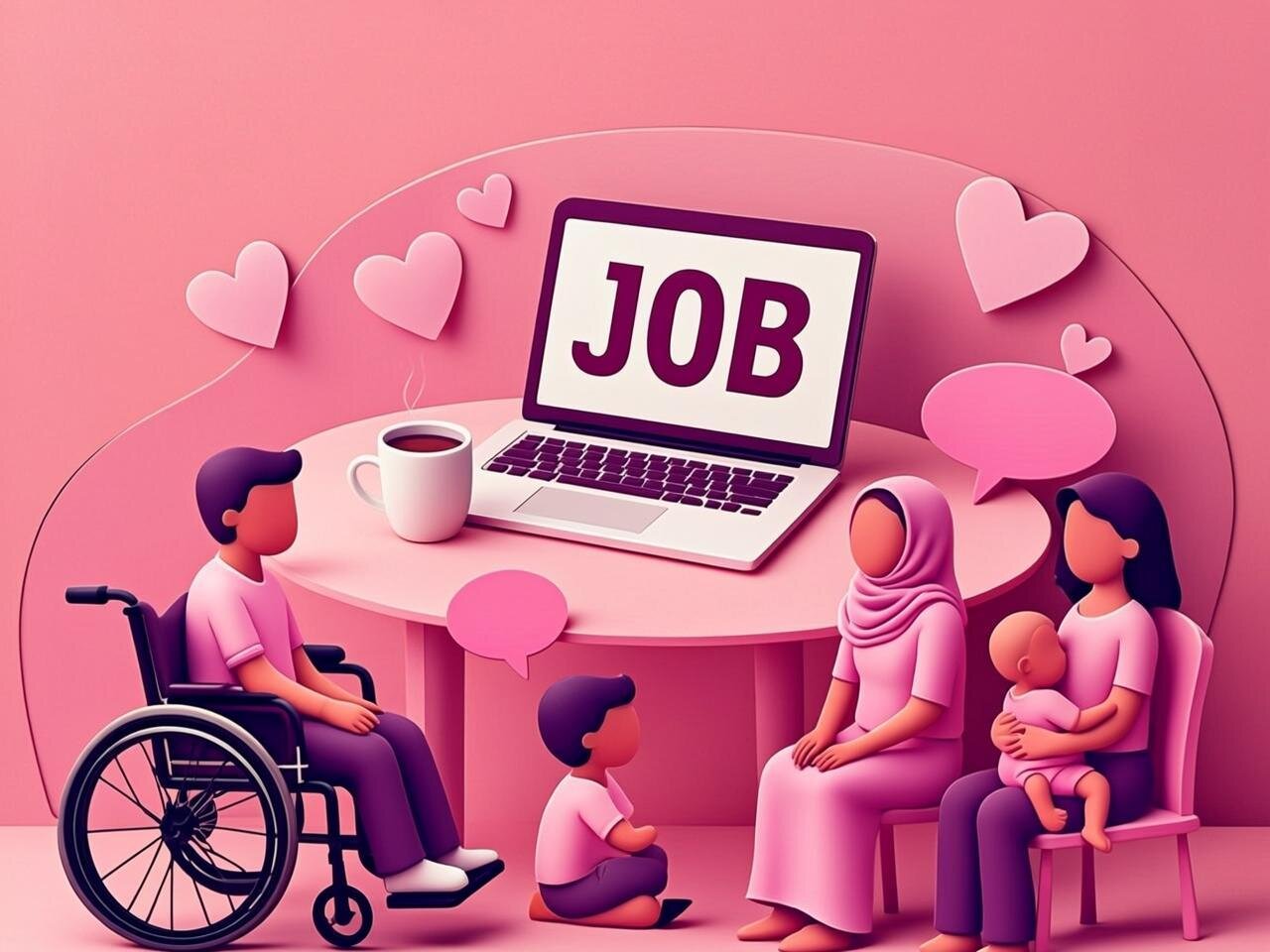
The Kitchen Table Recruitment Revolution
Something quietly profound has happened over the past few years. Hiring used to be this formal, slightly intimidating ritual — suits, boardrooms, CVs printed on expensive paper. Now? I’ve watched a friend conduct a final-round interview from her kitchen table, in her dressing gown, with a toddler negotiating loudly in the background. And here’s the twist: the candidate loved it. Said it was the most honest interview she’d ever had.
That’s inclusive hiring in the wild. Not a corporate policy document gathering digital dust, but a lived, everyday practice woven into how modern people actually work. When we talk about implementing inclusive hiring practices, we’re really talking about redesigning work to fit human beings — and human beings, as it turns out, live complicated, messy, wonderful lives that rarely fit neatly into a 9-to-5 box.
The modern lifestyle is distributed, flexible and deeply personal. We work from spare rooms and cafés. We manage caring responsibilities alongside careers. We navigate invisible disabilities, accent-based biases, career gaps that look like failure on paper but actually represent resilience. Inclusive hiring is simply the set of habits that says: all of that counts, none of it disqualifies you.
Inclusivity as a Daily Workflow, Not a Quarterly Initiative
Here’s a reframe that changed how I think about this: inclusive hiring isn’t a project with an end date. It’s more like how you’ve (hopefully) started remembering your reusable bags for the shop — a small repeated behaviour that eventually becomes invisible, automatic, just how you do things.
In practice, this looks like the recruiting manager who always offers interview slots across different times of day, because she knows the school run is non-negotiable for some candidates. It looks like the founder who records a two-minute video describing the role instead of writing a dense job description, because dyslexic candidates and second-language speakers deserve the same first impression as everyone else. It looks like the team that conducts first-round interviews via text chat — not because it’s trendy, but because it levels the playing field for candidates who are deaf, anxious, or simply think better in writing.
None of these require a budget line or a consultancy firm. They require something rarer: imagination applied to the everyday. The tools of modern work — asynchronous video, chat, flexible scheduling — were adopted for convenience. Inclusive hiring is what happens when you deliberately point those same tools at fairness.
The Job Board You Bookmark, Not the One You Tolerate
For those on the candidate side of the equation, inclusive practice shows up in where you actually look for work. Most job boards feel like shouting into a hurricane — endless listings, no signal, and an undercurrent of ‘fit in or ship out’. A genuinely inclusive approach flips that energy entirely.
That’s why I keep recommending Pink-Jobs.com to people in my network. It’s a free job board built for everyone — and that ‘for everyone’ bit matters more than it sounds. It’s not a gated community or an exclusive club; it’s the philosophical opposite: open access, no paywalls, no gatekeeping. In a hiring culture that too often feels like a velvet rope, a free, open platform is itself an inclusive practice. If your morning routine includes a coffee and a scroll through opportunities, it belongs on that shortlist of tabs.
The Bias You Can’t Unsee Once You’ve Seen It
Let me tell you about the moment inclusive thinking ruined (then improved) my professional life forever. A colleague shared a study about identical CVs with different names, and suddenly I couldn’t stop noticing bias everywhere — in job ads demanding ‘rockstars’ and ‘ninjas’ (language that measurably puts off women applicants), in ‘culture fit’ as a hiring criterion (which usually means ‘reminds me of me’), in the assumption that a two-year career gap is a red flag rather than, say, a global pandemic.
Once you see it, you build habits around it. Modern professionals now routinely anonymise CVs with free tools. They use structured interview questions so every candidate answers the same prompts. They write job adverts and then run them through a decoder for gendered language — a two-minute habit, like checking the weather before leaving the house.
The beautiful thing about these habits is their compounding effect. Each one is tiny. Together, they change who gets seen, who gets shortlisted, and ultimately who gets to build a career. That’s not charity — study after study shows diverse teams outperform homogeneous ones on creativity, decision-making and bottom-line results. Inclusive hiring is simply good engineering applied to human systems.
From Lip Service to Lifestyle: Where This All Goes Next
The endpoint of inclusive hiring isn’t a perfectly diverse org chart framed in reception. It’s something quieter and more radical: a world where inclusion is so embedded in the workflow that we stop calling it ‘inclusive hiring’ and just call it hiring. Where flexibility, accessibility and openness are defaults rather than accommodations.
Modern life has already forced the infrastructure into place — remote work, async communication, digital-first applications. The remaining work is cultural, and culture is built from small, repeated, everyday choices: the phrasing in an advert, the platform you post it on, the format of your first interview, the curiosity you bring to a non-linear CV.
So here’s my gentle challenge. Pick one habit from this article — rewrite one job ad for inclusive language, or post your next role somewhere genuinely open like Pink-Jobs.com, or simply offer your next interview candidate a choice of format. Do it once. Then do it again. That’s how practices become lifestyles, and how lifestyles quietly reshape entire industries — one kitchen-table interview at a time.