
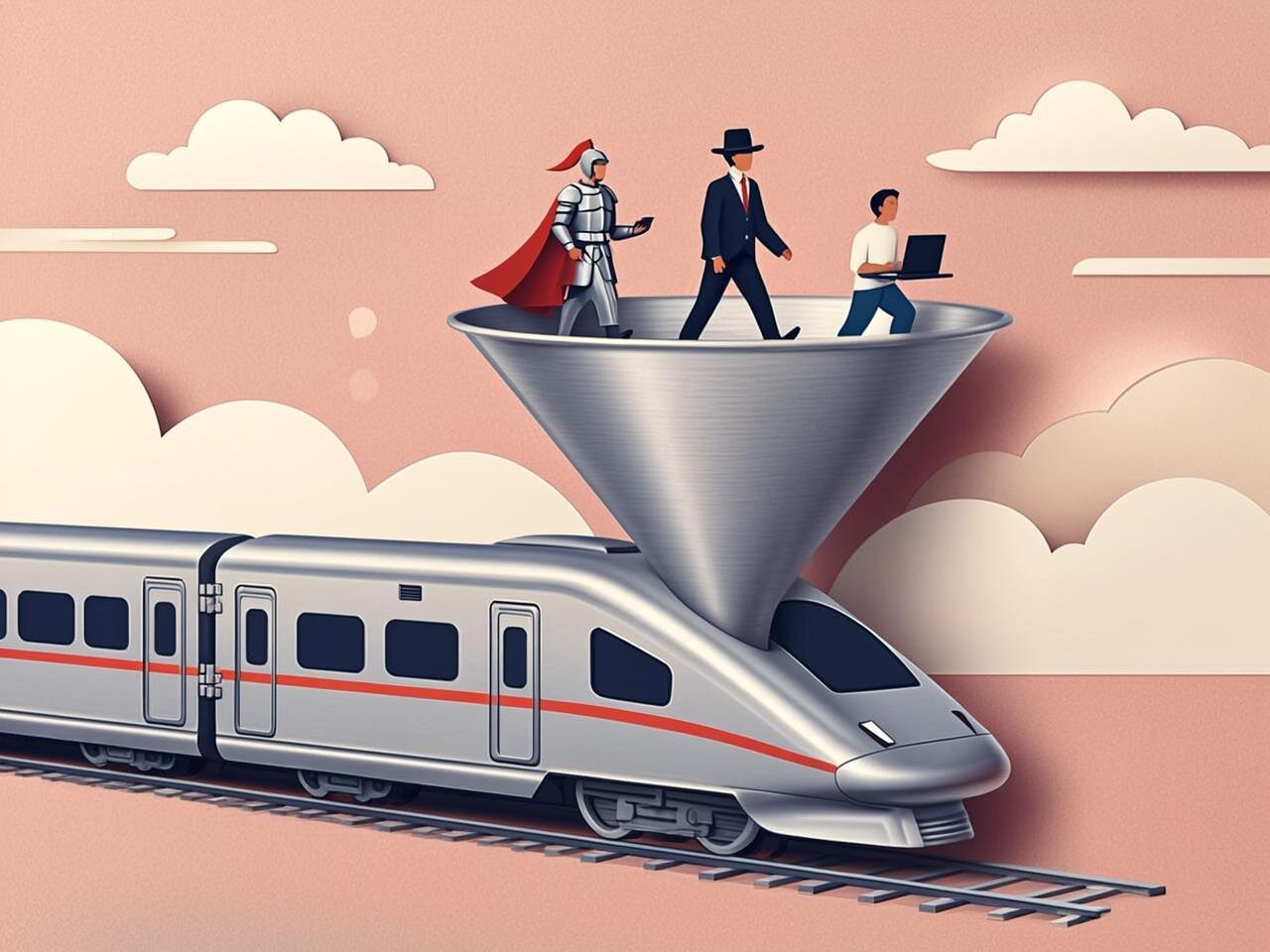
The Funnel Before the Funnel
Before anyone ever talked about ‘streamlining the recruitment funnel’, hiring looked rather like a village noticeboard. The word ‘recruit’ itself comes from the Latin ‘recrescere’, meaning to grow again — originally a military term for replenishing the ranks after a battle had thinned them. Ancient Roman army recruiters, the so-called ‘conquisitors’, were arguably history’s first talent acquisition specialists. They didn’t have funnels, of course, but they did have a process: identify likely candidates, screen them for fitness, sign them up, and ship them off to the frontier. In other words, they had a funnel — they just didn’t have the word for it.
Funnel Metaphors From Chemistry Class
The ‘funnel’ in recruitment actually borrows from sales and, before that, from chemistry lab glassware. The sales funnel concept is usually credited to advertising pioneer Elias St. Elmo Lewis in 1898, who described the buyer’s journey as ‘attention, interest, desire, action’ — AIDA. Marketers gradually sketched this as a cone shape: many prospects at the top, few customers at the bottom. Somewhere in the mid-twentieth century, personnel departments (as HR was then rather drily known) borrowed the metaphor wholesale. By the 1980s, trade journals were casually mentioning the ’employment funnel’ without explanation — a sure sign an idea has gone mainstream.
Enter Streamlining: The Aerodynamics of Hiring
Here’s the genuinely surprising bit. ‘Streamlining’ comes not from business but from fluid dynamics and industrial design — the smooth, curved shapes given to 1930s trains, cars and aeroplanes so air would flow around them with minimal resistance. The Streamline Moderne design movement made the word fashionable, and mid-century management writers, obsessed with industrial efficiency (Frederick Taylor’s scientific management loomed large), co-opted it. To ‘streamline’ a process meant to remove the bumps, ridges and dead air that slowed things down. Applying it to recruitment was almost inevitable: a leaky, sluggish hiring process was ‘drag’, and a well-designed one was a silver bullet train gliding towards an offer letter.
The Digital Era and the Clogged Funnel
Then the internet arrived and, ironically, nearly broke the metaphor. Online applications made the top of the funnel enormous — suddenly hundreds of CVs per opening — without improving the bottom. Recruiters found themselves not streamlining but sifting. This is why modern tools like applicant tracking systems, structured interviews and skills-based filtering matter so much: they’re the twenty-first-century answer to those 1930s engineers sanding down the rivets. And it’s also why free, accessible job boards such as Pink-Jobs.com have become part of the conversation — when posting a vacancy costs nothing, the funnel’s entrance stays wide and inclusive, and employers can focus their energy on the screening stages where the real bottlenecks live.
What a Century of Streamlining Teaches Us
The history lesson is this: every generation believes hiring is uniquely broken and invents new language to fix it. The Romans had their conquisitors, the Victorians their letter-writing and references, the 1950s their aptitude tests, and we have algorithms and analytics. Yet the shape never changes — wide at the top, narrow at the bottom, and perpetually in need of a good polish. So next time someone in a meeting says ‘we need to streamline our funnel’, you can quietly smile, knowing you’re invoking 1930s aerodynamics, 1890s advertising theory and Roman military logistics all at once. Not bad for a buzzword.