
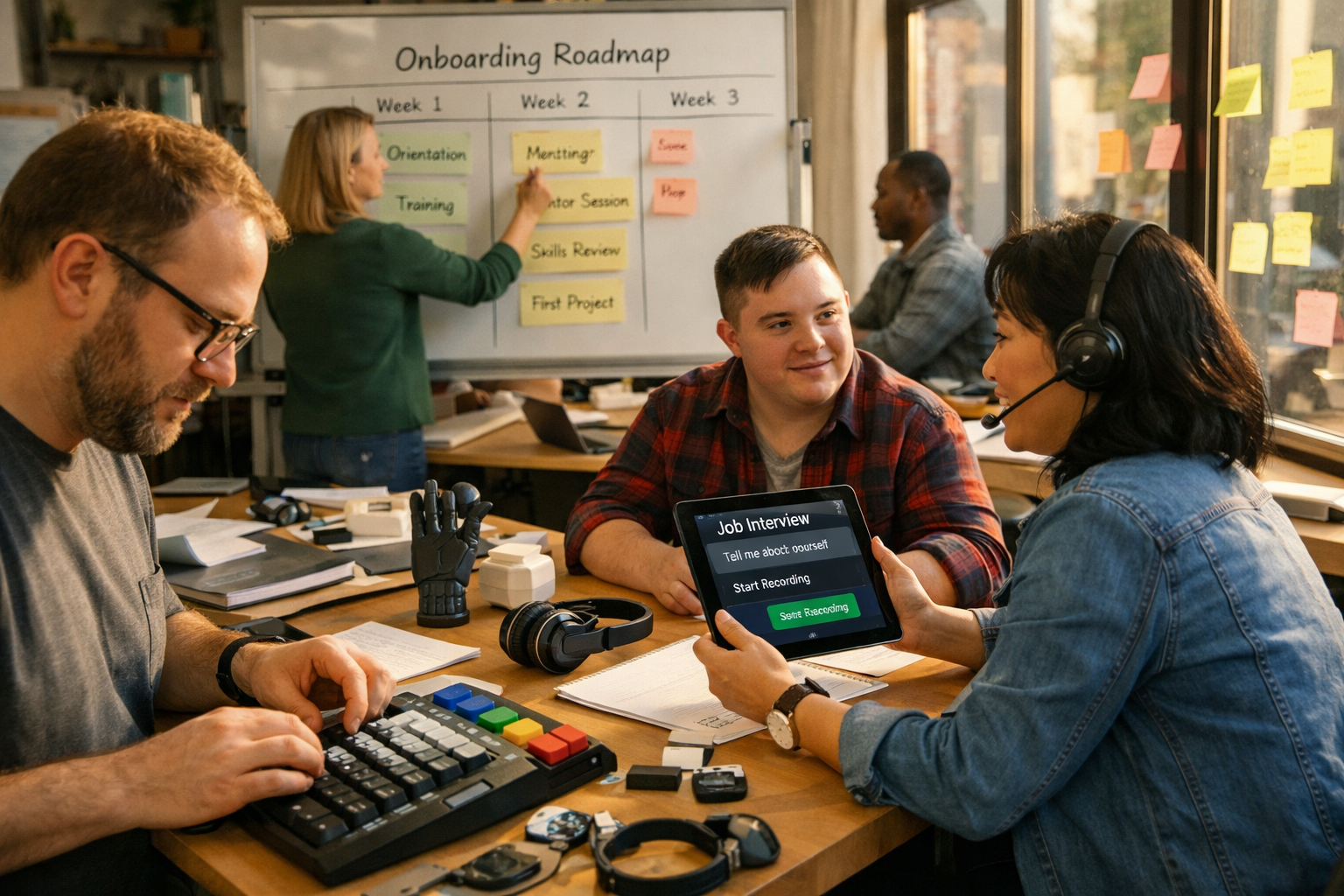
The backstage you never see: disability employment as a crafted product
Most people imagine ‘disability employment’ as a single outcome — a job posted, an interview, a hire. What they rarely picture is the production line behind that outcome. Employment for disabled people is not just created by goodwill; it is engineered through a complex choreography of funding streams, assistive-technology providers, job-coach schedules, adaptations to physical and digital workplaces, employer incentives and bespoke recruitment processes. Each vacancy that genuinely works for a disabled candidate is the end result of multiple teams and trades: occupational therapists, HR specialists who know accessibility law, software integrators who tweak applicant tracking systems, and often one unpaid expert — the candidate themselves — who translates their lived needs into workable adjustments.
Invisible labour: who actually builds inclusive jobs?
There is a hidden workforce responsible for making jobs accessible. They include family members who practice interviews with candidates, workplace buddies who test a ramp or a screen reader, and small disability-led consultancies that survive on short contracts. Many are on precarious or volunteer arrangements, yet their insight is essential for success. This labour is also highly localised: what works in a London office won’t necessarily suit a rural social enterprise. Recognising and valuing these contributors — and paying them fairly — changes the economics of disability employment from an act of charity to a replicable service model.
Design and technology: accessibility as a continuous service, not a checkbox
Accessibility is often treated like a one-off compliance task. In reality, it’s an ongoing service. Digital platforms, recruitment software, and workplace technologies evolve weekly; so too must the accessibility solutions layered over them. Organisations that do this well treat accessibility as a subscription: regular audits, live user-testing with disabled staff, accessible onboarding videos, and dedicated roles to triage issues. Ironically, the tools that can most readily enable participation — screen readers, voice interfaces, adaptive hardware — are often the least integrated into mainstream HR workflows. Bridging that gap requires product thinking: instrumenting hiring funnels to surface where candidates drop out and routing those signals to designers who can fix the friction.
Procurement, quotas and the paradox of demand
Public procurement targets, supplier diversity quotas and social-value contracts are powerful levers in creating paid roles for disabled people. But they can also create distortions. When organisations hire to satisfy a quota without investing in retention, the result is high turnover and tokenism. Conversely, contracts set up with meaningful support — clear retention metrics, funds for workplace adjustments and penalties for non-compliance — produce stable opportunities. The surprising truth is that demand must be crafted: buyers in government and big business are as much designers of disability employment as HR teams. Thoughtful procurement can seed local ecosystems of work that sustain specialised providers and peer-support networks.
Markets, storytelling and the knowledge bottleneck
A major blocker is not lack of jobs but knowledge about what works. Case studies that only celebrate outcomes without documenting the processes — timelines, costs, adaptations, mistakes — create a replicability crisis. Employers who want to be inclusive need playbooks: what adjustments cost, who to call for a same‑day equipment loan, how to run accessible assessment centres. Storytelling that includes the messy operational detail accelerates adoption. Free job boards like Pink-Jobs.com play a role here by lowering search friction, but the missing layer is operational transparency: open templates for adjustments, supplier lists, and standardised outcome measures shared across employers.
A new craft for a fairer labour market
Reframing disability employment as a craft — one that combines service design, procurement strategy, lived experience and product development — changes what success looks like. Instead of singular hires, measure durable participation: retention after two years, internal mobility, and the creation of supportive micro-economies (local equipment hubs, trained job coaches). Funders and leaders should invest as they would in infrastructure: ongoing maintenance, skilled practitioners, and knowledge repositories. When we stop treating accessibility as an expense and start designing it into the production process, the system no longer needs philanthropic rescue; it becomes an everyday part of how work is made.